This article was originally published on Transitions Magazine. Read the full version with original photos there.
A Czech robot offers a glimpse into the future of farming.
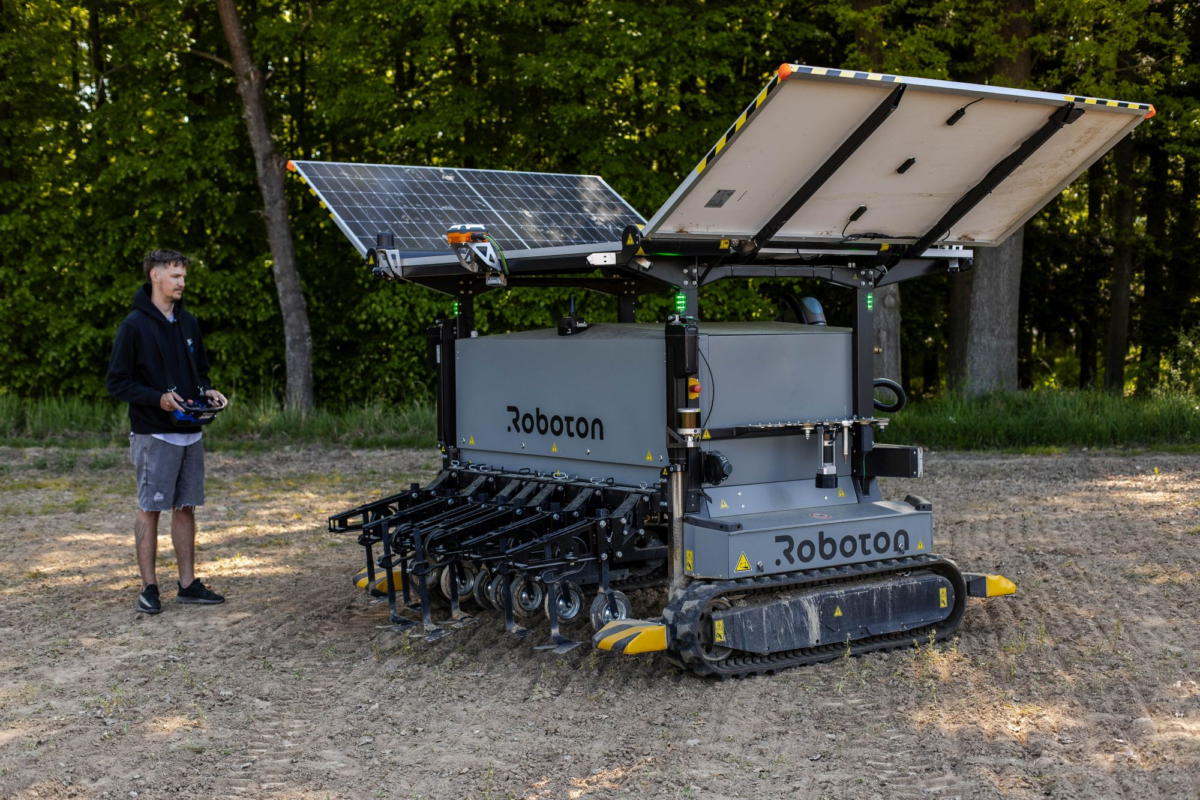
Imagine a farmer sitting by the water, fishing rod in hand, a smartphone lying beside them. Shouldn’t they be out in the fields? They are. Just not in person all the time. With a few taps on an app, they can command a solar-powered robot about the size of a small garden shed. It tills the soil, sows the seeds, waters plants, and pulls weeds – all autonomously. This was the reality for Marek Rericha, a South Bohemian garlic grower, who was one of the first farmers in the Czech Republic to test the new Roboton Farmer.
Behind this innovation lies a pressing issue: Czech farms, following the worldwide trend, face a growing labor shortage – estimated at around 5,000 people. The agricultural industry is struggling to attract the younger generation to this physically demanding, low-paying work.
“I can’t get young people out to the fields. They just don’t want to do this kind of work – and I don’t think that’s going to change,” Rericha says. “No one’s going to head out into the fields thinking they’ll make a fortune in agriculture.”
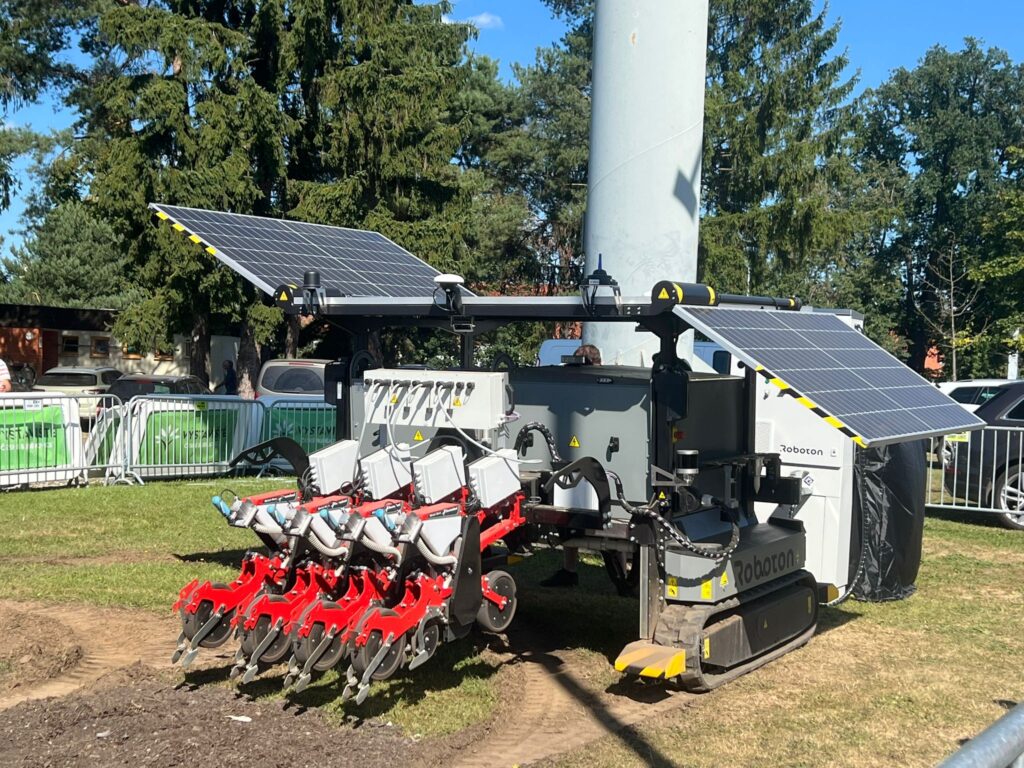
That is where a fully autonomous, solar-powered robot can come into play. It not only fills labor gaps but also outperforms a human driving a tractor. It can do its assigned tasks all day without a break, quietly and precisely. Depending on the task, the robot can automatically switch its tools.
The development of this robotic farmhand took roughly three and a half years of work by the South Bohemian company Terms. The testing phase is now complete, and Roboton Farmer should be on the market in 2026.
“We were inspired by the idea of returning to a form of farming that could be gentle on the soil, precise, and respectful of natural cycles but empowered by modern tools,” says Michaela Slavicek, the marketing director of the company.
Roboton Farmer will not be the only option on the market – autonomous robots from the Danish company Agrointelli and Dutch manufacturer Agxeed, among others, are already for sale across Europe.
What sets the Czech robot apart is its integrated solar system, says the company. According to Terms, the four solar panels atop the machine can supply up to 80% of its daily energy needs, depending on weather conditions. The robot can even connect itself to a charging station and refill its water tank without human intervention. That makes the technology not only efficient, but also sustainable and environmentally conscious, Terms says.

This season, the robot was loaned to three farmers who tested it under real-life conditions. At Rericha’s farm, it was used to tend carrots and onions, crops easier to manage than garlic, his main product. To ensure smooth operation, Rericha and the Roboton Farmer team had to set up the robot and prepare the fields in advance – installing a charging dock and GPS repeater, and ensuring water access was as close as possible. The rest of the work, apart from harvesting the crops, was on Roboton Farmer.
“I was mainly worried about maintenance, like if the robot got clogged up or dirty,” Rericha admits. “But it was virtually maintenance-free, which really surprised me.”
He also praises the on-call technical support from the Roboton team. According to Slavicek, the robot is designed for on-farm upkeep without specialist tools.
New Tech to Attract Young Minds
Still, the success of such technologies depends not only on their performance, but also on those who operate them. The Czech Ministry of Agriculture emphasizes the need for young qualified people who understand smart farming tools. “We are therefore rolling out a national grant program, through which selected high schools can receive funding primarily for the purchase of these technologies. As part of the program, schools are acquiring drones, agricultural robots, GPS-based navigation systems, and other smart technologies,” the ministry’s acting spokesperson, Karla Mrackova, says.
Vojtech Lukas, a researcher at Mendel University in Brno, believes that the industry’s workforce will evolve, moving away from manual roles toward remote operation and dispatching. “Whenever we offer courses like these, there’s always interest. Innovation in agriculture makes the field more attractive to young people,” says Lukas, who also teaches smart farming at the university.
The Roboton team hopes for the same. “If young people see that farming involves robotics, AI, data, and energy innovation, they might start to appreciate farming as both a skilled craft and a modern, tech-enabled profession,” adds Slavicek. Smart technologies like Roboton Farmer could do more than fill labor gaps – they might help to redefine what it means to work in agriculture.
For Rericha, after completing the trial period with the robot, the answer is clear: “I would for sure buy it, but the question is how much would it really cost. And it would also depend on how long the support from the team would last. I wouldn’t be lost without the people from Roboton, but it definitely made me much more comfortable knowing that I could call them for every little thing.”
While the robot has shown promising results during testing, its performance claims currently rely on data and feedback provided by the developer, Terms. An independent assessment will be only possible once the technology enters the commercial market next year.
Roboton Farmer is expected to carry an introductory price estimated at around 200,000 euros – a figure that puts it out of reach for many small farms, while being competitive with Agrointelli’s Robotti 150D (180,000 euros) or AgXeed models ranging from 200,000 to 350,000 euros. In comparison, a conventional diesel tractor with similar power output and pulling force costs around 30,000 euros. Next season, however, the Terms robot will be available for seasonal rental, making the technology more accessible. Another approach is collective ownership. Farmers can form associations and jointly invest in the equipment – a strategy already used in Austria.
While farmers in Czechia can already apply for subsidies covering certain smart technologies, financial support alone is not enough. What is still missing is legislation governing the use of autonomous machinery or application drones (drones used for specific commercial or professional tasks across various industries). According to the Ministry of Agriculture, a comprehensive framework is essential to prepare on the EU level, as innovations advance faster than the law.
That is essential for further progress in smart farming for Czechia, which holds strong potential for implementing new technologies – ironically thanks to the nationalization of farms under communism. As Lukas explains: “Compared to many other EU member states, we have a predominance of larger agricultural enterprises. It has often been criticized that the transformation of agriculture in the 1990s did not unfold entirely in an ideal way. Critics point to the fact that land was not returned to its former owners, or that more family farms failed to emerge. But it is precisely these larger companies that are able to equip themselves with such technologies.”
As Lukas observes, the motivation of independent farmers can be more compelling than that of a manager in a large company.While in large companies decisions about new technologies are handed down to employees from above, it is the small-scale farmers who lead the way with genuine enthusiasm. Rericha is such an example.
Smart Farming Needs to Get Smarter
According to a 2024 survey by the Prague-based Institute of Agricultural Economics and Information (IAEI), about a third of Czech farms already use precision farming technologies. Precision farming, a subcategory of smart farming, means treating various parts of a field differently – using data to understand what each area needs and adjusting farming practices to match.
The collection of data on the condition of soil and vegetation is one of the biggest strengths of new technologies. “The modernization of agriculture is not about robotization. It is mostly about information thanks to which we can approach the soil better,” Lukas says.
“We can use satellite data to detect whether a plant needs more or less fertilizer,” he continues. For example, by measuring how much light plants reflect, satellites can show which areas of a field are thriving and which are under stress. This level of precision can help optimize the usage of resources such as fertilizers, often improving efficiency, though just by a few percent. “On the other hand, even a 5% gain, when you calculate it for the entire farm over the whole financial year, is quite a lot,” Lukas adds.
The Roboton Farmer itself is capable of fine-tuning the job at hand through its sensors and the use of artificial intelligence. Its smart irrigation system can calculate the exact amount of water needed for each zone, reducing waste, Terms says. Preliminary field tests suggest water savings of up to 35%.
However, the 2024 IAEI survey shows that fewer than half a percent of Czech farms use any form of robotic technology. That indicates that the adoption of tools like Roboton Farmer is still in its early stages.
Terms acknowledges that moving from prototypes to full-scale deployment is going to be a challenge. Yet, for Czech agriculture, the next step is not just improving the smart tools, but preparing the system around it to support their growth. With targeted investment in education, clearer legislation, and support for small-scale farmers like Rericha with a tech-friendly attitude, Czechia could show the way to growing food more productively, with less pesticide use and environmental stress.